What Would Sell You a Pizza Online?

I don’t know what the last time you ordered a pizza online was, but someone in Domino’s Pizza’s marketing and/or web department needs a raise. The site is full of completely awesome copy. For instance: when you choose toppings for a pizza, they are divided into two categories:

  • meats
  • unmeats

This is a distinction I fully support.

When creating a pizza using their ordering interface, there is some fine print under the graphical representation of your pizza. (The graphical representation is also awesome; it is a photograph that reflects as you check on toppings/crusts what your final pizza will resemble.) The text reads:

The Pizza Builder will always show a large pizza. If you choose a different size, the topping amounts will vary. The deliciousness, however, will not.

This is a delightfully snarky way to tell you that they aren’t about to make a whole bunch of different graphics just to show you what will be on your pizza. Creative.

At the bottom of the screen is some text speaking about their 30-minute promise. It says:

Because safety is a priority, “You Got 30 Minutes™” is not a guarantee, but an estimate. You may get more.

Once again, we have what amounts to normally boring copy (legal instead of technical this time), but it’s been given a human flavor and just a little bit of an attitude. There’s personality behind this web copy, something I think is very important and should be rewarded. “You may get more” is funny in a direct way.

When you place your order, you also get to see using a “tracking service” where your pizza is in the creation process, including when it leaves the store to be delivered to your house. It even includes the names of the employees responsible for their parts in the process. It adds an unmistakably personal touch to the process of ordering a pizza on a web site—which by its very nature is an impersonal process.

Hats off.

What about you? Have you ever had an experience with a web site for a store or establishment that goes that extra mile to make things feel more personal and connected? Do you prefer a formal, business-language approach, or something that’s more informal and down-to-earth?
eBook Prices versus Print Prices – Are They Too High?

Are eBook prices edging a little too high for people’s comfort? Josh Quittner writes in Time:

If only the Kindle 2 were cheaper! Despite its other shortcomings, Amazon’s new and improved digital-book reading device does enough right that it could become the Model T of e-readers, capturing the imagination–and discretionary spending–of the masses. But in this wretched economy, in which most of us will purchase only nonessentials that save us money or make us money, I doubt folks will pony up $359 for a pleasure-reading gadget. And thanks to Amazon’s mysterious pricing policies, the old argument–that digital books are so much cheaper than their hide-bound ancestors–no longer holds.

Before a recent visit to my dear old mum, I purchased The Kindly Ones, by Jonathan Littell, a 992-page Nazi-palooza that, given the nearly 3-lb. weight of the new English translation, makes for an ideal Kindle selection. But when I got ready to buy it on Amazon, I blanched at the $16.19 price. Every Kindle text I’ve purchased since Amazon started selling the device in November 2007 has been $9.99. Indeed, that was one of the Kindle’s main draws: you could buy books wirelessly, on demand and at a fraction of the cost of their printed peers. Case in point: Littell’s book was listed in Amazon’s Kindle store with a hardcover price of $29.99, making the digital version seem like a real bargain. But later I discovered that Amazon’s bookstore was selling the new hardcover for $17.99. So the Kindle saved me all of $1.80. Big whoop.

Customers aren’t stupid. They realize that an eBook like that on the Kindle or on other electronic bookstores doesn’t cost as much to print, warehouse, or to distribute—because those things don’t cost anything. Quittner himself writes about an “old argument” that “digital books are… cheaper” than print pieces. A lot of people are used to purchasing a large portion of their books at the $9.99 price point on Kindle, because that’s an automatic discount applied to both new titles and to titles on the NYT bestseller list.

What shows the intelligence of the customer is that I don’t recall any publisher ever saying in public that eBooks would be less expensive than print ones. Amazon makes a big to-do about the $9.99 price point, enough so that Quittner believes in his article that Amazon is also the one who set the list price for the book he was trying to buy. (This is not true; list prices are set by publishers; Amazon decides what the sale price is, at least when it comes to Kindle titles. I don’t know how the print side of things works.) Customers are intuiting that digital books should not cost as much as print ones.

I ran into this myself just a few days ago. Now having the Kindle app for iPhone, I went to look at a few books to see if I wanted to buy anything. I landed on a book that in print is a mass market paperback. Its Kindle price? $7.99—identical to the pricing of the hard copy version. I don’t think I need to write long on how quickly that decision was made for me.

Companies—and this is not limited to publishers—are underestimating the human desire to own physical objects. To many people (and at least to me), physical ownership of a piece of property, such as a DVD on which a video game is coded, or a stack of paper on which words are printed, is more valuable than a collection of bits that make up even a functionally equivalent electronic version of the same product. In addition, I have more control over the physical piece of property, especially when DRM enters the picture on electronic files and I’m being told what I can and can’t do with it.

What do you think? When you have a choice, which one would you buy? Would you buy both? What do you expect to pay for it?

Discuss, and feel free to answer the poll in the sidebar.

I'm Fairly Certain I Did This Last Year, Too

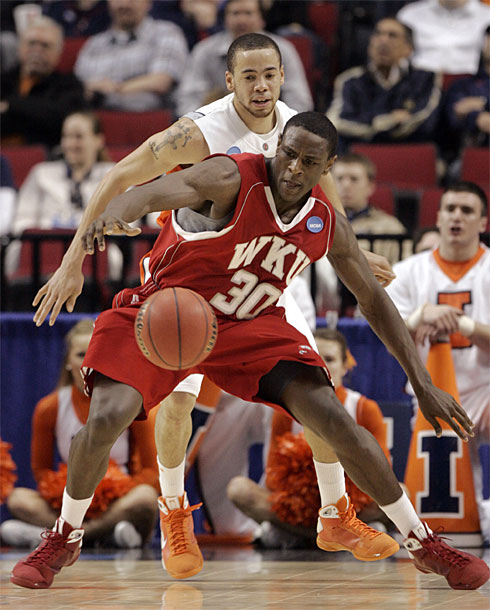
wku-round1

Yup; I did.

Bring on Gonzaga. Let’s do this.

links for 2009-03-19

Because Some of You May Not Be Familiar with Fake Plastic Rock

I realize that not everyone who reads may have an understanding of what Rock Band is and why it’s perhaps one of the greatest timesinks I’ve ever run across. I post often about it and will even throw up YouTube videos of note charts for songs I’m really interested in. For those of you who might need a small primer, I present to you this series of videos and explanations.

Rock Band is a “rhythm game”. What that means is that you are handed some music in the form of a track playing on your television courtesy of a video game system. You are also handed a plastic instrument. The first game to tackle this idea handed you a guitar. In Rock Band, there are four instruments: Guitar, Bass, Drums, and Vocals. Each plays slightly differently. The goal is to hit the right “notes” within a certain “window” of a graphic crossing your screen.

The game comes on a disc with about 80 songs, and there are weekly releases of downloadable songs you can purchase and play. The songs cost $2 each, which is a steal considering you’re not only hearing the music, but you’re also “playing” it.

To save those of you who might not want to load everything, I’ll put the rest behind a cut; please read on if you are interested.

Continue reading