The Objectives of Baseball and the Line Score

A good first start for talking about how to play or watch a game is to begin with speaking of how you win said game. The objective of the game of baseball is deceptively simple:

At the end of nine innings, the team that has scored more runs is the winner.

This is a simple concept for those who have followed baseball for years, but for someone new to the game, I have just introduced three new concepts in that one sentence. We’ll break things down even more over time, but to help you in your understanding of how a game is won, the best place to start is to also teach you how to read the line score.

An Example Line Score and How to Read It

The best example is a real one. Here’s the completed line score as seen on from a game between the St. Louis Cardinals and the Chicago Cubs, played in St. Louis:
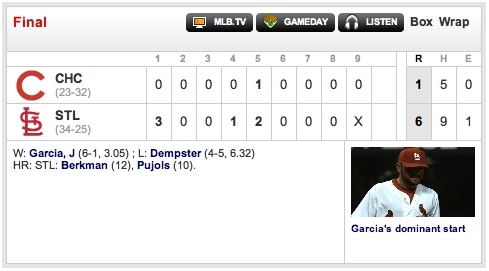
A few notes about how the line score is composed:

  • The home team (the team in whose city the game is played) is always at the bottom half of the line score. This is not merely cosmetic; the home team is granted an advantage in the game by batting last in each inning.
  • At the right end of the line score is the running total for the three basic stats for each team in the game. These are:
    • Runs, which are the only scoring tally in baseball and were discussed in the game objective above. A run is scored when a batter successfully reaches each of the four bases in succession and touches home plate,
    • Hits, which are recorded when a batter strikes the ball with his bat and successfully reaches base before being put out, and
    • Errors, which are officially recorded defensive mistakes where an out should have been made with what is termed “ordinary effort” but the defensive player did not succeed.
  • Some line scores will include a running total labeled LOB, which indicates runners who were left on base (or “stranded”) by reaching base but not touching home plate before the end of their team’s offensive half of an inning.
  • The remainder of the line score is broken into a grid that shows the number of runs scored in each half-inning. The game starts at the top of the first inning and proceeds from there.
  • In this line score, you can see that St. Louis won the game, with the final score being six to one.

Innings

A game of baseball is broken into nine innings. Each inning has a top and a bottom, according to the place in the line score. I’ll put the line score back up so you can see that again:

In the top half of each inning, the visiting team plays offense and the home team plays defense. This continues until the defense records three outs, which is called retiring the side.

After the third out, the teams switch sides and play the bottom half of the inning, likewise until three outs are recorded. The home team plays offense in the bottom half of all innings to give them an advantage, especially in later innings.

As an example, look at the fifth inning in this line score.

In the top of the fifth, the Cubs scored one run before their three outs, and the Cardinals scored two runs in the bottom of the fifth before their three outs.

(We’ll talk more about how outs work later.)

Note that there’s no clock in baseball of any kind. A team is permitted to continue their half of a given inning until three of their players are put out. There’s no limit to the number of batters who come up in a half-inning, and no rule placing a maximum on the number of runs that can be scored.

Two things to note about innings and how they work:

  • If a game is tied at the end of the ninth inning, additional innings are added to the end of the game until there is a winner. Both halves of the inning are always played to give the home team the chance to answer any leads by the visiting team. This is called extra innings.
  • If the home team has more runs after the top of the ninth inning, the bottom half of the ninth inning is not played. You can see this in the box score above, being marked with an “X”. Similarly, if the home team scores to take the lead at any point in the bottom of the ninth inning or in the bottom of any extra inning, the game immediately ends when that run scores (since there is no point in continuing play).

The Basics

What you’ve read here is the minimum necessary to understand how the game is scored and how your team wins the game. In future posts, I’ll cover more of the concepts listed here, such as how an out is made, how runs are scored, and how teams play offense and defense.

If you have any questions, please leave a comment. I’ll be happy to answer them for you.

Maroon 5 Pack 02

Good sight-reads (includes one track that was released in the first pack but I hadn’t cleared in RB3 yet). 🙂 Chord-heavy, but generally fun to play and some decent challenge in there with the patterns.

Maroon 5 is one of those bands I enjoy listening to for reasons that aren’t quite clear even to me. I was happy to see some more tracks in the Music Store.

Baseball for People Who Don’t Know Anything about Baseball

For lots of Americans, the game of baseball is something that has deep cultural and family connections. For people like myself, my father, and my children, we have grown up listening to and watching baseball, both in person and through various media. Because of this, lots of Americans have an ingrained understanding of the game, the rules, and the various complexities behind it.

Baseball is, as a game, very interesting and rich in strategy and statistical depth. You can watch it and follow it on many different levels.

But what if you haven’t been steeped in this American tradition? What if you come from lands distant, or if you had never seen a baseball game? Are you going to a game for the first time? Are you interested in learning about another sport, one with a storied history and tradition? Are you marrying someone who is a baseball super-fan but you don’t know the first thing about a foul ball, a bunt, or an infield fly?

The following posts are for you. In them, I’ll try to explain the basics of baseball, then moving into more complex aspects of the game, using “real” language and images whenever possible to highlight specific things about the game. It can be difficult to get a handle on the game at first, as many of the rules and concepts are inter-related. It’s hard to know where to start.

If, as you read, and as I write these posts, you have questions or you feel confused, please feel free to add a comment and ask your question or suggest an additional post. I will do what I can to build on this guide based on the needs of its readers.

I’ve added a link in the navigation for this site for these posts; I’ll also try to update this lead post with a table of contents of sorts to try and keep things organized.

Frozen Synapse

I don’t play too many games at my desk anymore; I generally prefer to keep to the console stuff and leave my computer for work and such. But when two places I tend to trust (Penny Arcade and my fellows over at Quarter to Three) recommended the same game at almost the same time, I took notice and decided to bite on a copy.

So here’s my short review of Frozen Synapse:

Take the planning part of the original Rainbow Six—you know, the part that was the best thing about it until they removed it from the game series—and make a game out of that. It’s that awesome.

In the default gametype, you are given four soldiers, of varying types, and your opponent is given the same. You start on opposite ends of a map with rooms, short walls to shoot over and cover behind, and doorways, and you give pathway commands to your dudes. You can have them aim in a certain direction, ignore or focus on enemies, go to different areas, and change tactics all by planning their routes and how you want them to go about their way.

Each player submits their commands and then the game proceeds for five seconds as you watch your respective orders fire at the same time. A game lasts as long as eight turns, so all the action happens in 40 seconds or less. When a match is concluded, the whole thing looks like this:

Of course, it takes a bit longer to compose your orders, as you get to change them between each turn, and you can run simulations based on what you think your opponent will do to help you figure out the best plan of attack. The game can even be played asynchronously, where you each submit your respective turns and then the game emails you to let you know you need to come back.

For $20, you get a copy for yourself and a copy for a friend. It’s a pretty good deal, and you support indie game development by buying it. Find out more here.

“Love Is a Battlefield” (And a Pleasant Rock Band Surprise)

A couple of weeks ago I picked up the Pat Benatar pack for Rock Band, mostly out of curiosity. Last night I played “Love Is a Battlefield” for the first time and found it to be a lot more fun than I was expecting. I suppose I hadn’t listened to what the guitar was doing in the background before.

I did 95% on sightread, which was good enough for 1,496th on the leaderboard.

It’s not the best Benatar on Rock Band, though; that honor goes to “Heartbreaker.”

My Rock Band activity page is here, by the way. I really wish Harmonix provided RSS feeds or another way to ingest this information elsewhere. I turned on the Facebook integration today, but I prefer to bring this stuff into my own site where I can control it.